Environmental Information Network
2026
Sustainable Excellence Award
Winner
Central IT - UXD Team & Environmental Risk Monitoring Team, HON HAI TECHNOLOGY GROUP (FOXCONN)
Designers / Creators / Authors / Leaders
TzuPei Chen, LiFang Wan

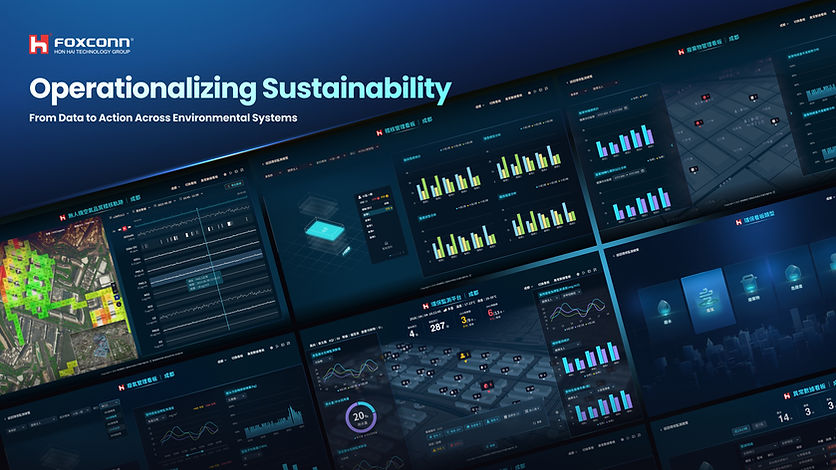
Environmental management has never lacked data. What it lacked was a system that turns data into action. The Environmental Information Network was built around one core question: “What does a manager need most during an emergency?” This defined our “1 Master + N Modules” architecture, allowing users to drill down from a park-wide overview to individual sensor readings with the right information density at every level.
The modular platform supports flexible expansion based on park needs and currently integrates wastewater, emissions, solid waste, hazardous storage, compliance audits, and drone inspections. Deployed in a global technology industrial park, it serves three user tiers: executives tracking KPIs, managers monitoring risks, and frontline staff receiving actionable alerts.
Key features include 3D spatial navigation, drone inspection integration, and unattended auto-rotation mode for command centers, transforming sustainability data into measurable ESG assets.
Environmental Information Network stands out for its role-based intelligence, closed-loop governance, and ability to turn environmental data into business value. Key features include the following:
(1) Role-Based Architecture: Executives monitor ESG risks, managers oversee dynamics, and operators receive SOP-guided alerts. Noise is filtered and friction reduced.
(2) Anomaly Loop: Links warnings to resolution reporting. Each incident generates an auditable record, transforming compliance into proactive governance.
(3) 3D Drill-Down: Users navigate from satellite views through floors to discharge points, anchoring data to physical space for faster response.
(4) Drone Integration: Heat maps of VOCs, PM2.5, and NO2 on flight paths convert raw data into auditing documentation.
(5) Asset Dashboard: Recycling rates and efficiency metrics translate sustainability into corporate KPI language.
The Environmental Information Network maintains a consistent visual language across six environmental domains. Whether monitoring wastewater or managing audits, users follow the same navigation logic, reducing cognitive load during emergencies.
The platform transforms environmental departments from cost centers into strategic contributors. Resource reuse and pollution reduction trends integrate directly into ESG reports, giving teams greater business visibility. Its modular architecture supports rapid expansion, multilingual access, and cross-device adaptation.
Already deployed across manufacturing parks in Yantai, Chengdu, and Longhua in China and expanding into Vietnam, the platform establishes a globally scalable foundation for environmental governance and digital management.